
Author: RITree

Right Tree Right Place: The Smart Strategy for Safer and Healthier Landscapes

Trees are smart investments for homeowners. They provide numerous ecological, environmental and economic benefits. However, many homeowners plant trees without considering their future growth. The result? Increased maintenance, damaged infrastructure, and wasted investment. What’s most disappointing is the fact that these problems are avoidable. All it takes is a bit of planning. Fortunately, there is a very simple, effective strategy for planting for success. It’s called Right Tree Right Place (RTRP).

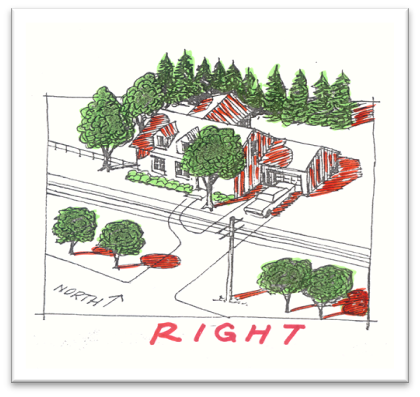
The Right Tree Right Place concept was introduced to the world of arboriculture in the late mid-70’s by the National Arbor Day Foundation in Tree City USA Bulletin #4 entitled “The Right Tree for the Right Place” (www.arborday.org). This bulletin is a simple primer on what to consider before planting. Two of the best illustrations are found on the bulletin’s front cover. They appear side by side and show how tree choice and tree location are inextricably linked. Breaking their connection causes problems. The key is to learn and follow the RTRP approach. The result will be a lifetime of satisfaction for you and your trees.

Source: Arbor Day Foundation. Bulletin #4. www.arborday.org.
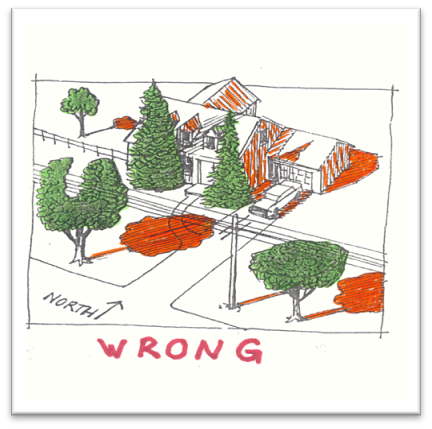
WHY TREE PLACEMENT MATTERS
The Right Tree Right Place is a two-step process. The first step evaluates the planting location (i.e., tree placement); the second the choice of tree species. In Step 1 the goal is to screen the site for its suitability. A checklist of factors to consider are:

  • Soil: Is it wet or dry, acidic or alkaline? Does it drain well or poorly? A soil test will answer these questions. Also, how much soil area (100sf, 500sf, 1,000sf) will be available for plant root growth?
  • Exposure: Is the planting site mostly sunny, partially shaded, or mostly shaded? Many trees have specific daylight requirements to thrive.
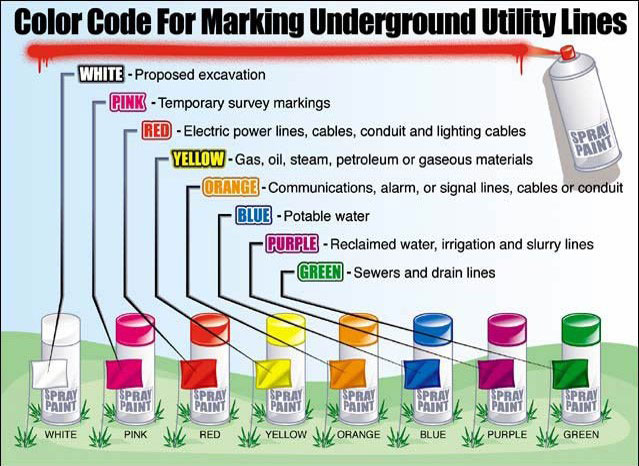
  • Underground Utilities: Are there any sewer, water, natural gas, fiber optic or other utility lines within the planting area? Contact DIG SAFE for these answers.
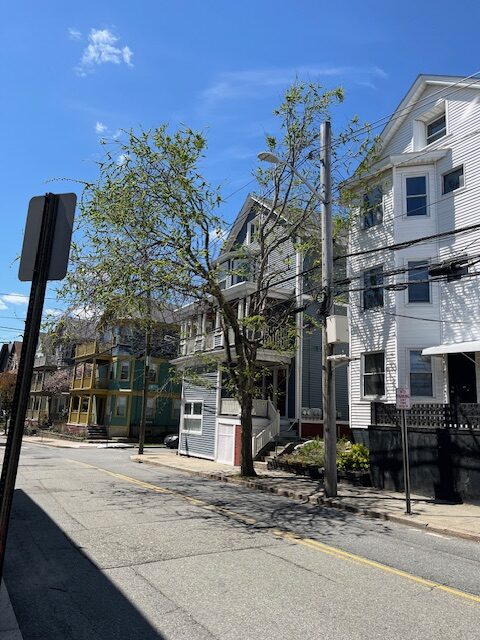
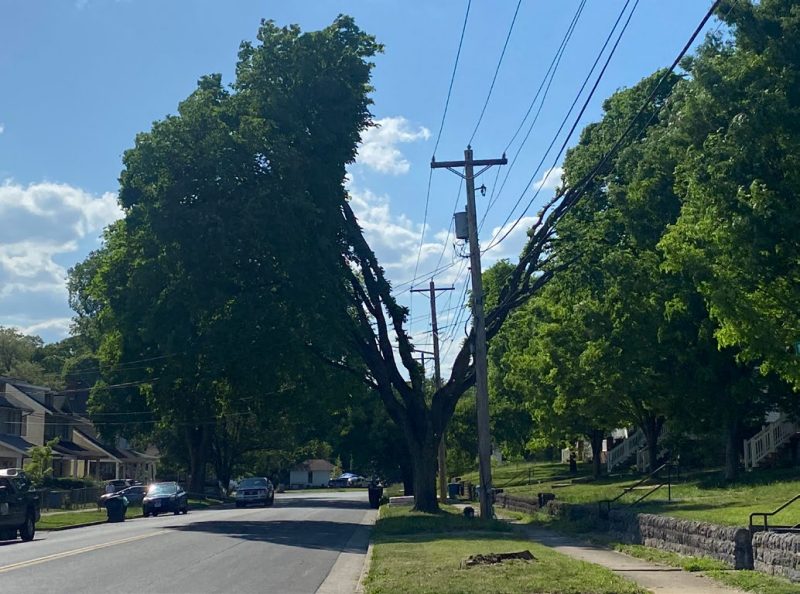
  • Overhead Utilities: Are there electricity, telephone or cable power lines to contend with? What is their height above the ground?
  • Built Structures: What is the distance from the planting area to the home, garage, shed, children’s play area, etc.? Consider driveways and walkways as well.

This exercise is invaluable for what it reveals about the planting location. All are not equal. Few are found perfect. But most have one or more issues to overcome. They are red flags that often lead to poor tree placement. The most common of these are:

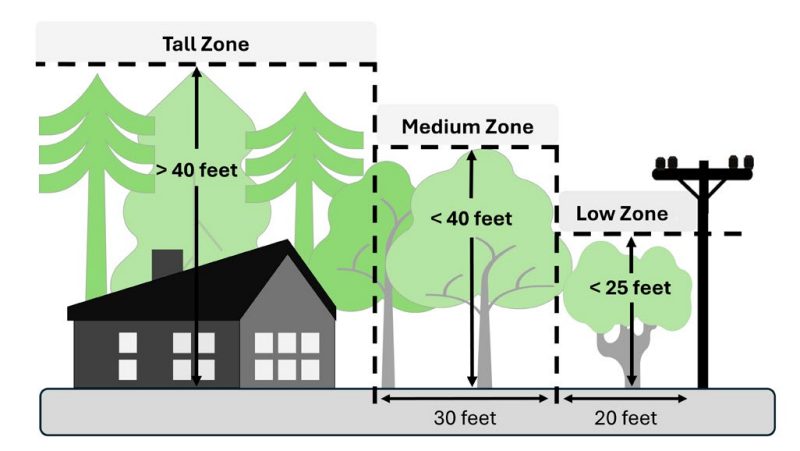
  • Power line conflicts: Trees planted under or near power lines require extensive trimming, often leading to misshapen growth and increased maintenance costs.
  • Property damage: Tree branches and root systems can damage foundations, driveways, and underground pipe systems.
  • Blocked sunlight: Planting trees too close to a dwelling can reduce natural light and encourage moisture problems.
  • Reduced benefits: Improper tree placement may require intensive measures to correct which often lead to failing tree health, life expectancy and benefits.

Avoiding these issues and others are critical. There are several options. One may be as simple as picking a better location. Another has to do with the choice of trees. That’s the focus of Step 2.
MATCHING TREES TO SITE CONDITIONS
While there are literally thousands of tree species to choose from, only a handful may be a good match for the planting location. In step 2, the goal is to winnow down these choices. This is not as difficult as it seems. But it does require general knowledge of trees, namely, their major characteristics. For example, all trees have common features such as roots, stems and leaves. However, not all are sun-loving, fast growing or adapted to a wide range of soil conditions. The key is to find the tree species whose characteristics or traits best align with the planting location, keeping in mind the latter’s limitations and/or restrictions. Just as with step 1 there is a checklist of traits to consider:

  • What is the mature size (width and height) of the tree?
  • What is the general shape of the tree; upright, wide-spreading, or rounded?
  • Does the tree prefer sun, partial shade, or full shade for its best growth?
  • Will the tree tolerate the existing soil moisture conditions?

There are many fine reference books to assist with species’ research. The RI Tree Council recommends the following:

  • Manual of Woody Landscape Plants. Michael A. Dirr.
  • Dirr’s Encyclopedia of Trees and Shrubs. Michael A. Dirr. 2011. Timber Press. Portland, OR.
  • Trees of the Northern United States and Canada. 1995. John Laird Farrar. International Society of Arboriculture. Champaign, IL.

Once this exercise is completed, the link between the tree location and tree choice should become obvious. Both steps in this process worked to prevent mistakes. For example, the prospective planting location may be dry, have all-day sun, and within 25’ of the home or overhead power line. Red oak and linden perform well in sunny exposures and are adaptable to a wide range of soil moisture conditions. But they are large growing trees—both will easily reach 80’ tall and wide at maturity. They need plenty of room—much more than 25’—to avoid future conflicts with power lines, the home, or other structures. Under these circumstances, Red oak and linden are bad choices. They are wisely ruled out for further consideration. The good news is there is a tree for every niche. In the end, there are 11 species—cherry, magnolia, maples, silverbell, etc.—to choose from. All thrive in full sun, and all are tolerant of low soil moisture. Anyone would be a good match for the planting location.

PLAN BEFORE YOU PLANT
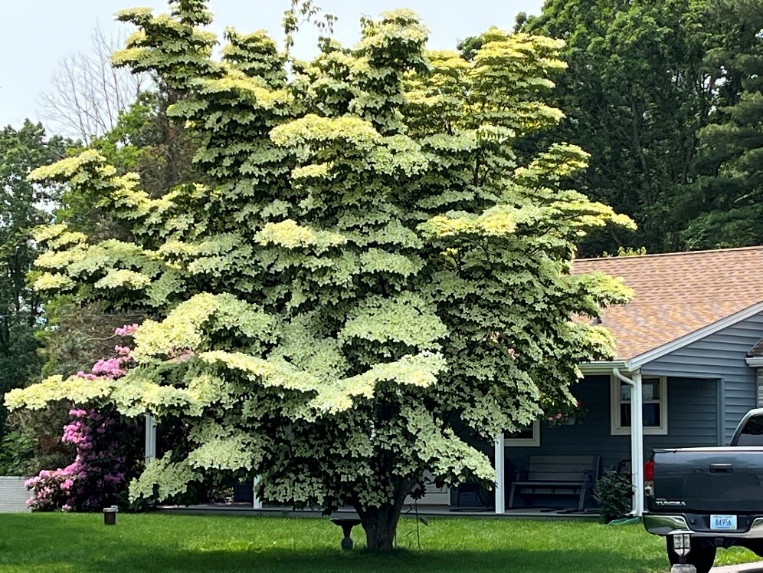
Right Tree Right Place is not only a sensible step but also a cost-conscious choice. This approach matches a tree’s characteristics—mature size, shape and growth habits—to a site’s conditions. It also emphasizes a tree’s long-term compatibility with the planting location. The trees included in this strategy require less pruning, have fewer health problems, and avoid conflicts with structures such as homes, sidewalks, and electric utility power lines.

Tree planting isn’t just about the present. It’s also about the future. Savvy decision-makers think in terms of 10, 20 or even 50 years from now.

Finally, planting a tree should be a rewarding experience, not a source of ongoing problems. By embracing the Right Tree Right Place philosophy, you can make smarter decisions that benefit both your property and the environment. A little planning today can save years of effort tomorrow. Choose wisely, plant carefully and give your trees the space they need to thrive. Hit a home run for trees!

This introduction on the Right Tree Right Place strategy was the first of many articles soon to appear at www.ritree.org.

How to Plant a Tree

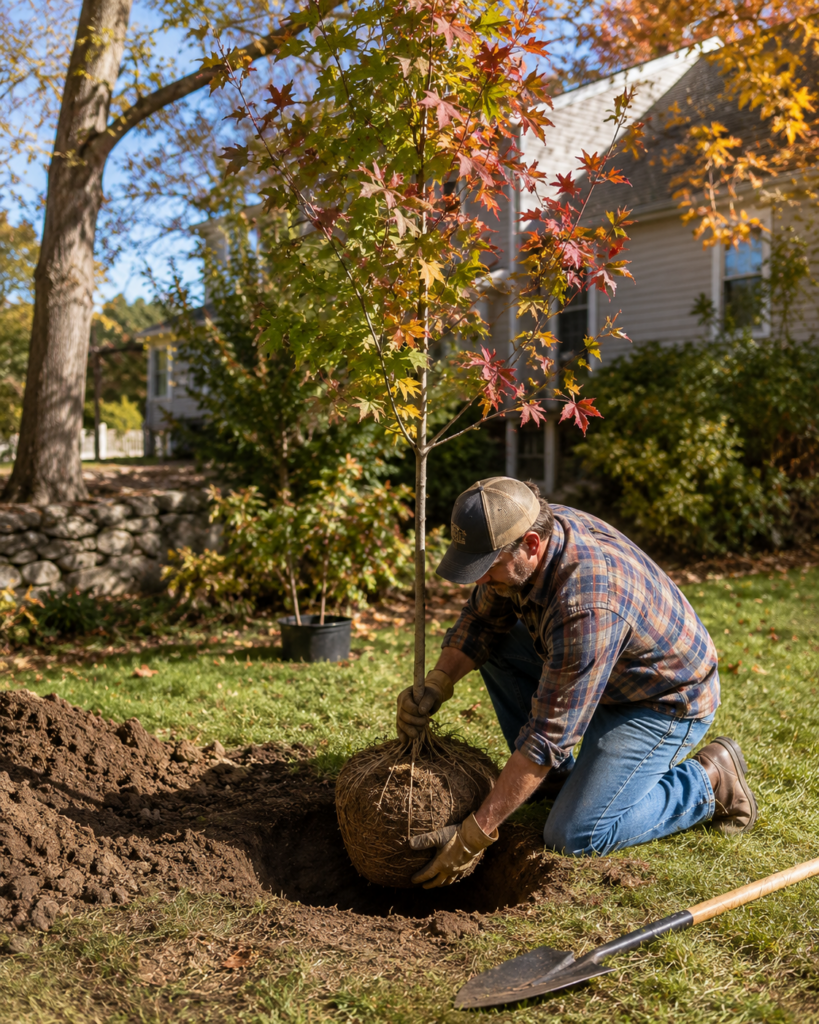
Planting a tree is simple when you follow a few key steps — and getting them right makes the difference between a tree that struggles and one that thrives. In southern New England, the best times to plant are early spring, before trees leaf out, or fall, from late September through mid-November, when cooler temperatures allow roots to establish before winter.

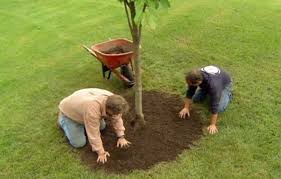
Dig the right hole. Make the hole two to three times wider than the root ball but no deeper than the root ball is tall. Planting too deep is one of the most common mistakes and one of the hardest to recover from. The root flare — the spot where the trunk widens at the base — should sit at or slightly above grade.

Skip the amendments. Research consistently shows that backfilling with native soil, rather than enriched mixes, encourages roots to spread outward into the surrounding ground. Save the compost for the surface.

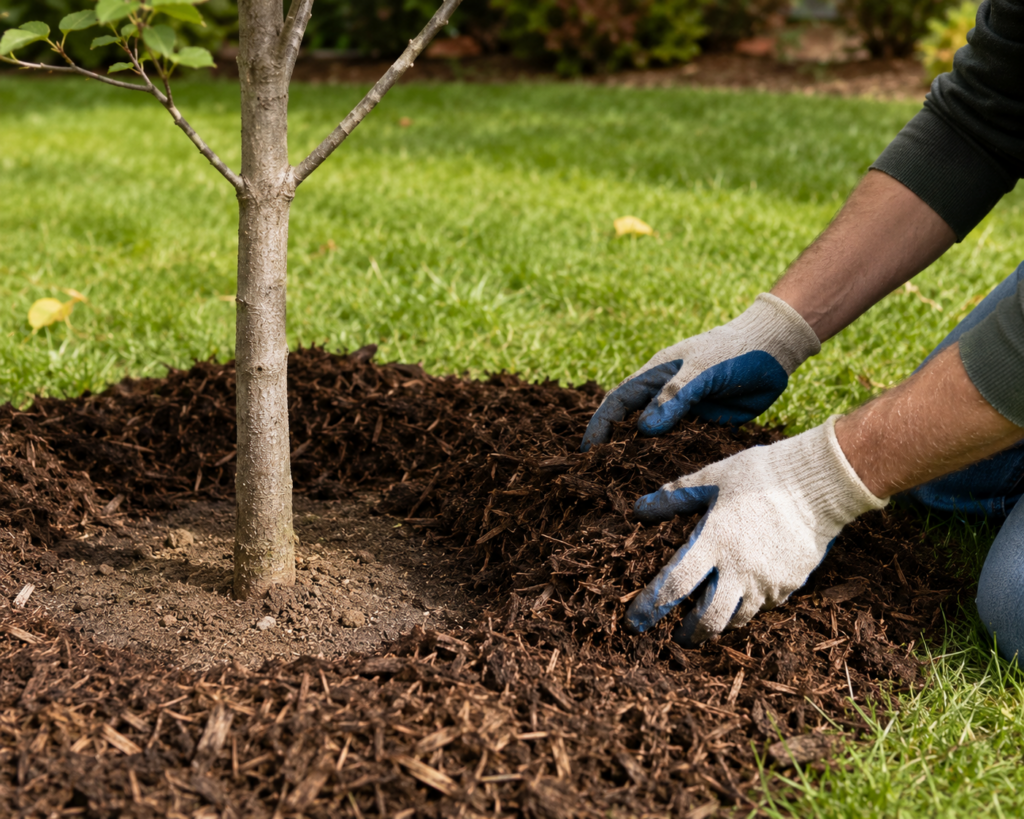
Water thoroughly and mulch well. Give the tree a deep soak right after planting, and plan to water weekly during dry spells throughout the first growing season. Apply two to four inches of wood chip mulch in a wide ring around the tree, keeping it away from the trunk. Mulch conserves moisture, moderates soil temperature, and suppresses competing grass.

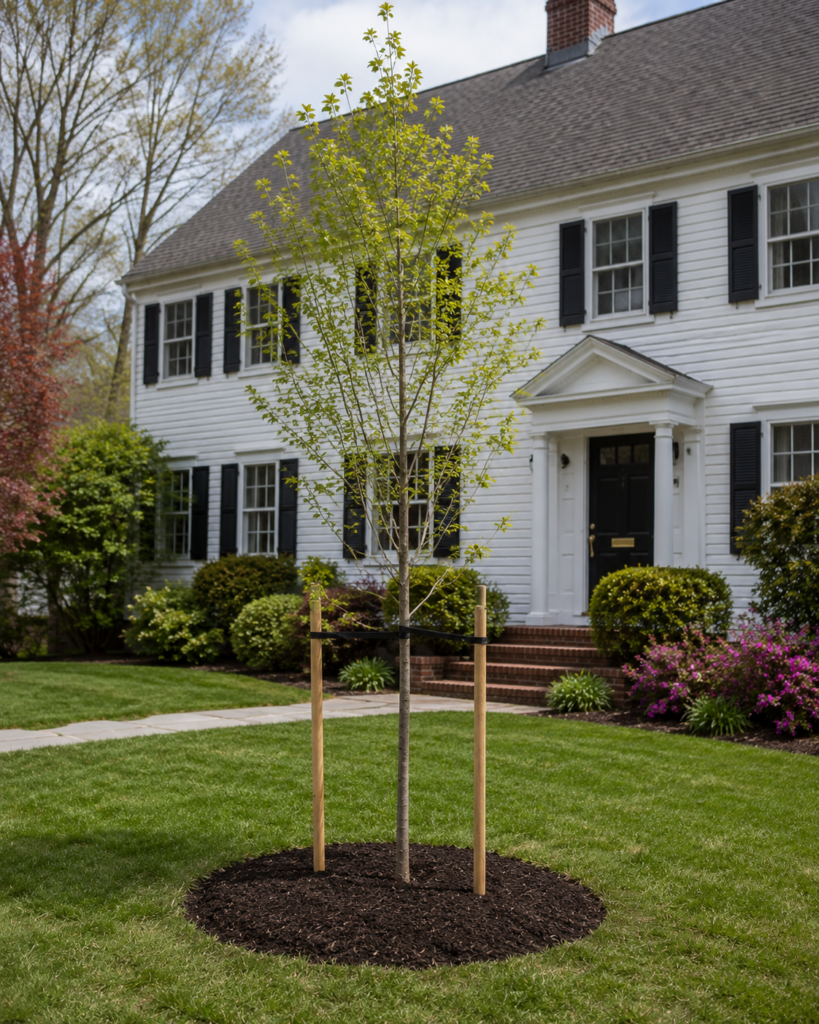
Stake only if necessary. Most trees don’t need staking. If the tree can’t stand on its own, use two flexible stakes and soft ties, and remove them after one year.

A little patience goes a long way. The first year a tree sleeps, the second it creeps, the third it leaps — and the investment pays off for decades to come.

Plant Native Trees

When you choose a native tree for your Rhode Island landscape, you’re doing more than adding shade or curb appeal — you’re restoring a piece of the ecosystem that has been here for thousands of years. Native trees co-evolved with local insects, birds, and soil microbes, making them far more valuable to wildlife than ornamentals imported from other continents.

Southern New England is home to an impressive palette of native trees suited to almost any site. Red maple thrives in wet or dry conditions and puts on a brilliant fall show. Swamp white oak tolerates seasonal flooding and becomes a majestic long-lived canopy tree. Black gum, also known as tupelo, offers some of the finest scarlet fall color of any tree in the region and is a favorite of native bees in late summer. Serviceberry blooms early in spring before most other trees leaf out, providing critical nectar for early pollinators and berries for migrating birds.

Native trees also tend to require less care once established. They’re adapted to Rhode Island’s soils, its wet springs and summer droughts, and its cold winters. That means less watering, less fertilizing, and fewer pest problems over the long run.

If you’re not sure which native tree suits your site, the Rhode Island Tree Council can help. Matching the right species to your soil, light, and space is the first step toward a tree that will thrive for generations.

Goddard Park Highlight

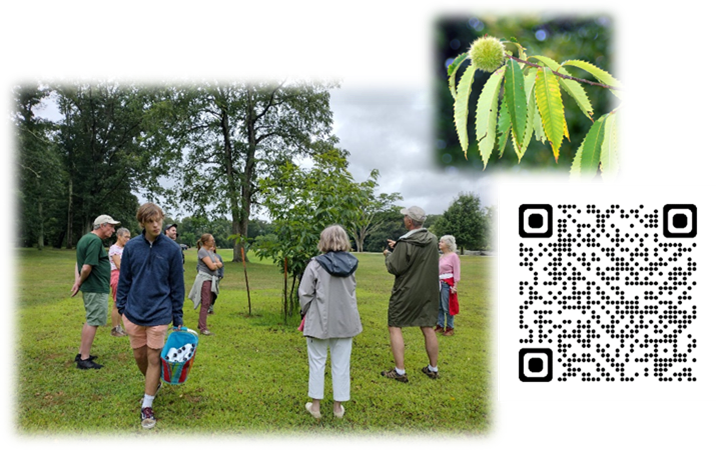
A highlight of the Tree Council’s 2023 Summer Workshop at Goddard Park was a chance to see years of work by the American Chestnut Foundation come to literal fruition.  Since the American Chestnut demise in the American landscape (A fungal blight has left the trees stunted), people concerned by the absence of this tree in our forests, have assembled a team, and concocted a scheme, whereby these wonderful chestnut trees may be rescued from a future of understory inadequacy.  Through breeding selection, resistance to this fungus has been sought. The project is looking fruitful. 

It is a wonderful story of science, passion, and hope.

Pursue the link below to see more.

RITree’s Flowering Tree Spotlight

There is an abundance of beautiful flowering trees to chose from. In this series we will highlight one tree at a time to become familiar with.

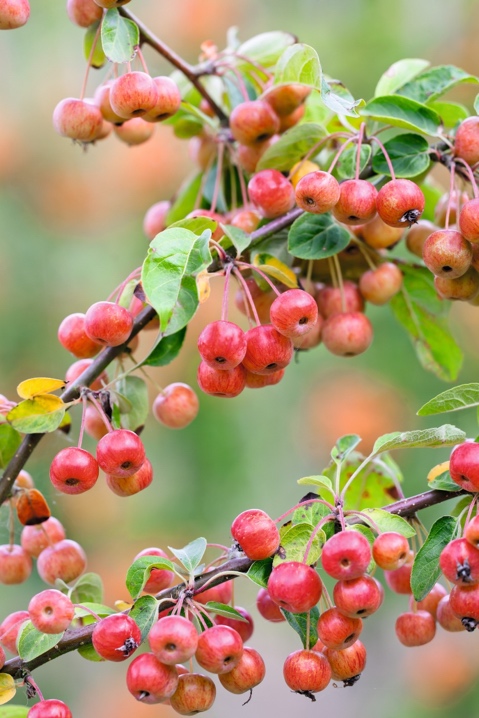
Crabapple, Malus Spp.

A great choice if you are looking for a compact tree that brings year round interest. Gorgeous spring buds, handsome summer foliage, and great fall color are some of the crabapple’s main draws. Typically, this tree stays below 20’.

Botanical Name : Malus Spp.

Zone:4-8

Size: 15-20’ (there are dwarf varieties available)

Spread: 15-20’

Exposure: Full sun

Bloom time: Mid-late spring fragrant white, pink, magenta or red blooms last for 1-2 weeks. Fruit ripens late summer to mid-fall. Most cultivars have red fruit, but you can find yellow, maroon and orange.

Growth rate: Moderate

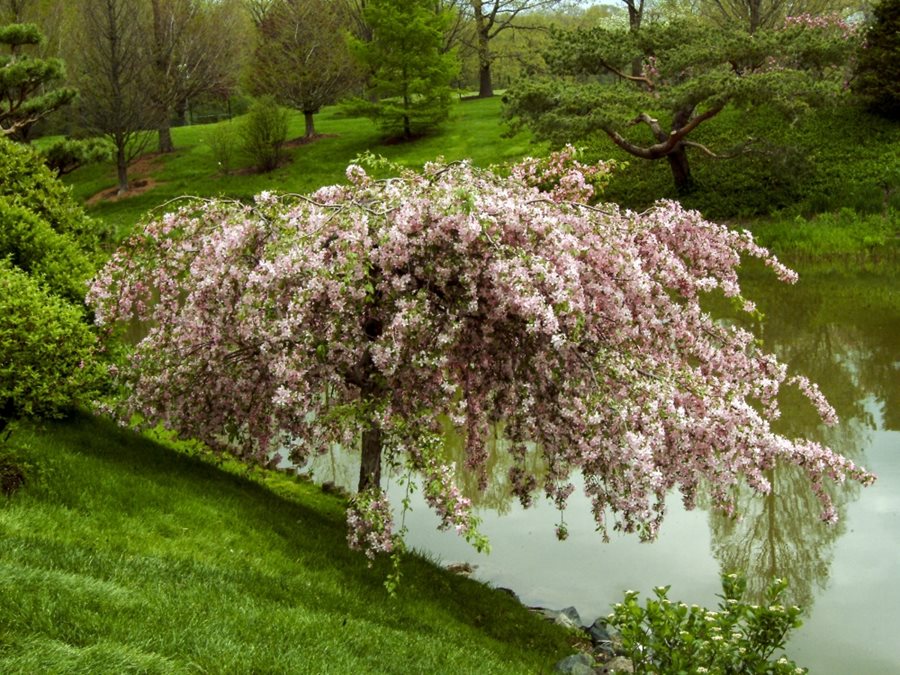
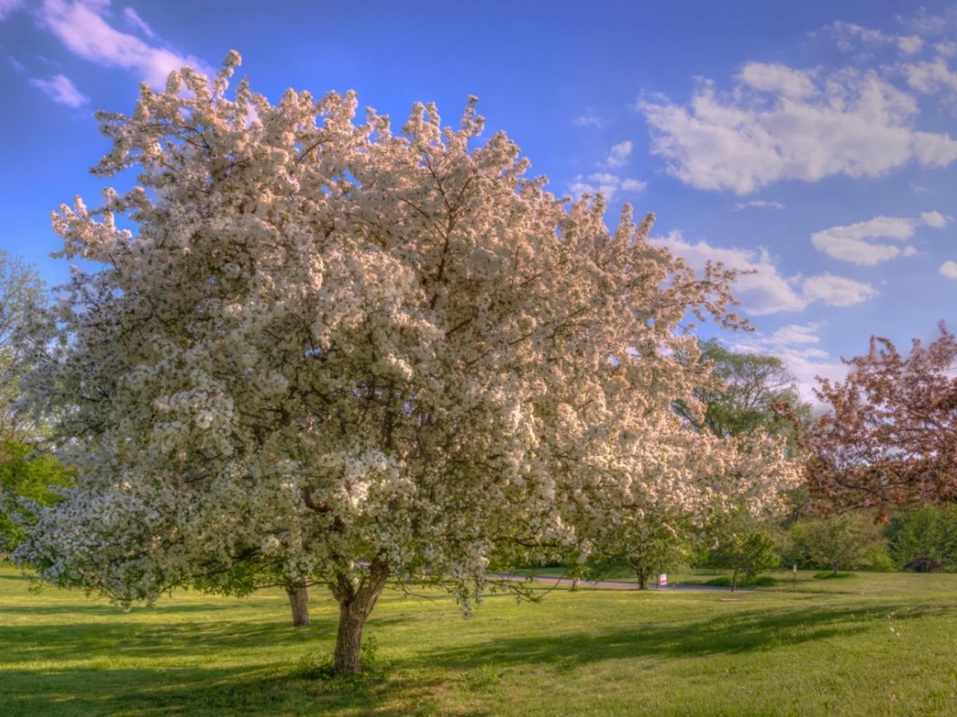
Crabapples come in all shapes and sizes, including spreading, weeping, dwarf, vase-shaped and columnar.
This photo features a weeping Louisa Crabapple. These can grow to 12-15’
Crabapples’ flowers bloom at dlightly different times depending on the cultivar. A design consideration is whether to have multiple types to have blooms for longer, or the same type and have an explosion of fragrance and color simultaneously.
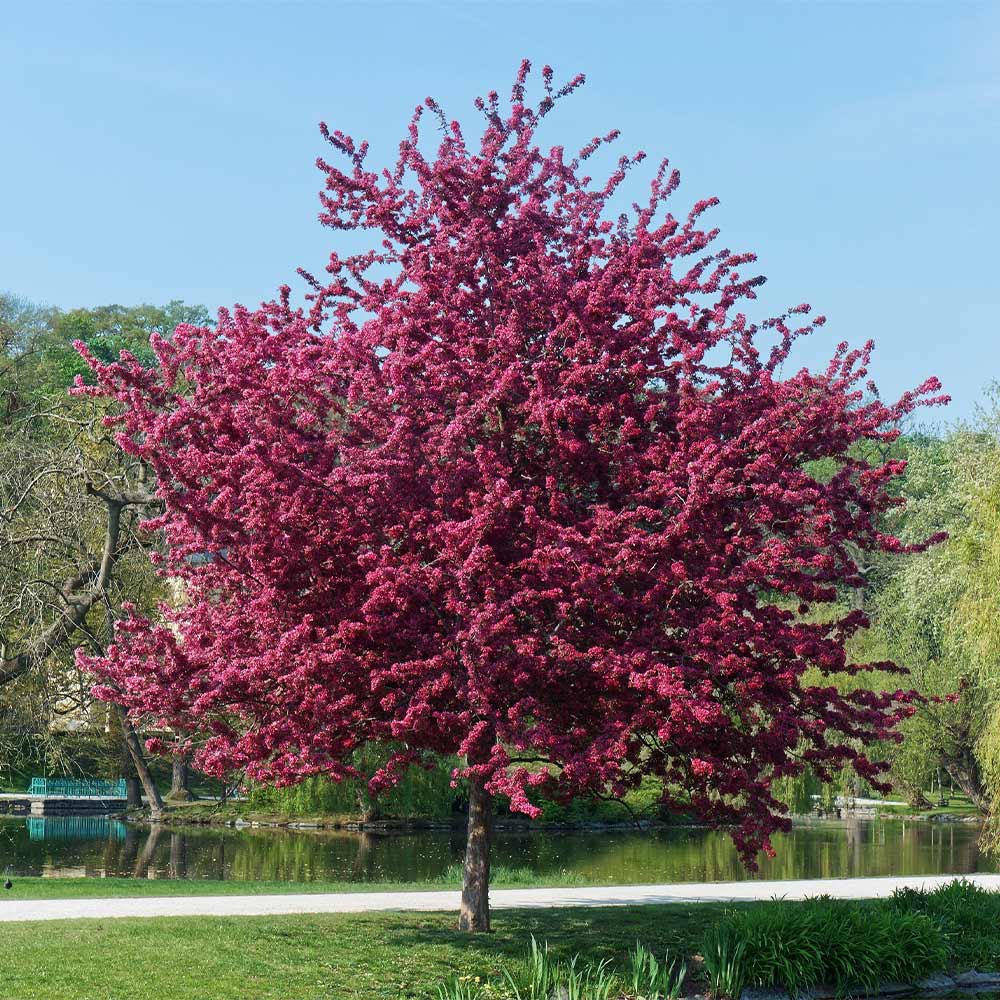
The royal raindrops cultivar reaches 15’ with bright buds and purple foliage.
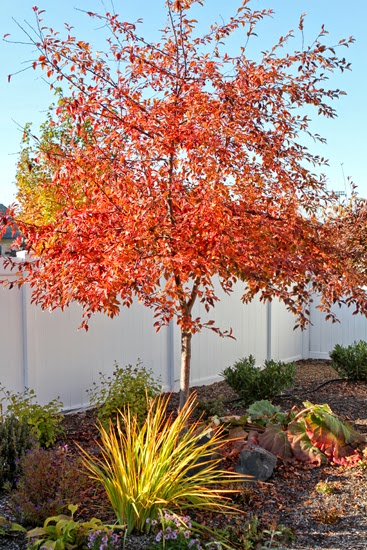
Royal Raindrops’ Fall Color
Crabapples’ fruit is not just ornamental, it provides much needed wildlife value.
Often too sour for humans, the fruit comes in a variety of sizes and colors
depending on the cultivar.
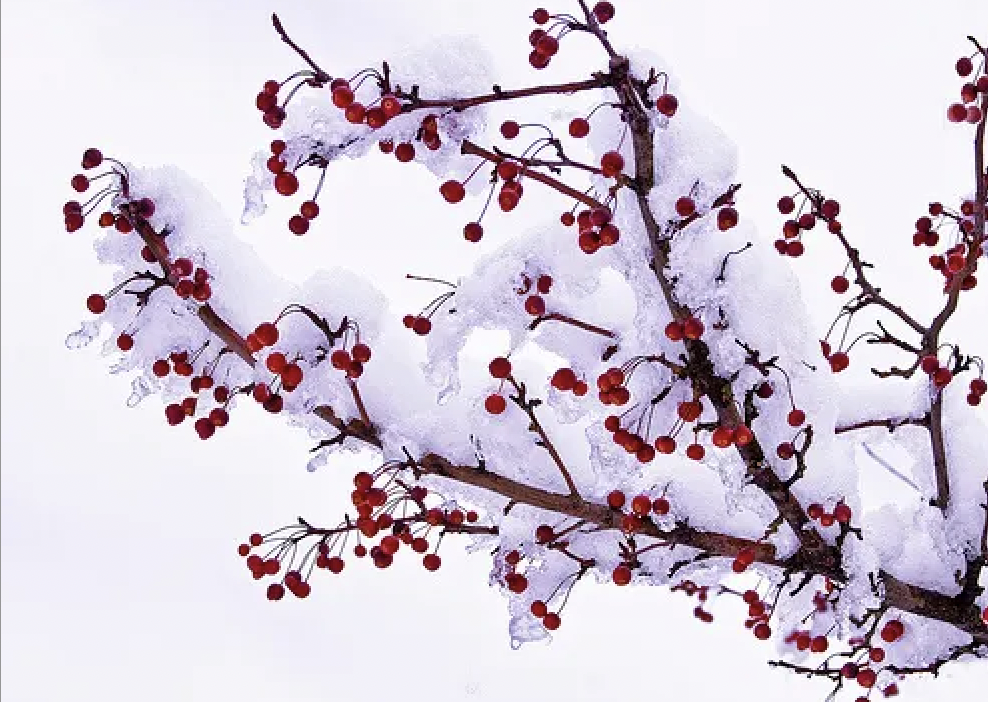
Some culitvars such as M. ‘Guinevere’ provide winter interest with the fruit.

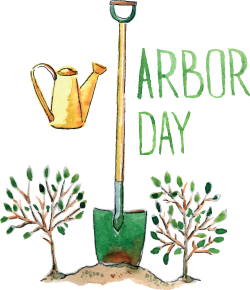
RI Tree to Host Arbor Day Celebration in Newport

John Campanini

Technical Director, RI Tree Council

PROVIDENCE, RI, April 17, 2023 — Rhode Island Tree Council (RI Tree) will hold this year’s Arbor Day celebration at Miantonomi Park, Hillside Avenue, Newport, RI, on Friday, April 28, starting at 10:30 am. The event will be hosted by the city of Newport, the Newport Tree Conservancy, and the Newport Tree and Open Space Commission. The event’s primary sponsor is the Rhode Island Energy Corporation, PPL.  The event’s secondary sponsors are the Rhode Island Tree Council and the Rhode Island Department of Environmental Management.  

The Newport event marks Rhode Island’s 136th observance of Arbor Day, which recognizes the critical contributions of trees and forests to humanity. Governor Dan McKee will speak at the event and read the RI Arbor Day Proclamation. Children from nearby schools also will participate in the festivities. RI Tree will plant maple, elm, linden, and dogwood saplings as part of the celebration. COVID-19 restrictions will apply. RITree invites everyone to come and join in the day. 

Rhode Island has had a long history with Arbor Day. According to the RI Department of Education records, the first event held in Rhode Island to honor trees occurred on April 29, 1886. Sponsored by the Barrington Rural Improvement Society, the ceremony took place on public land near the railroad station in West Barrington. 

Assisted by Society members, school children planted an American elm and dedicated it to the memory of the 16th President of the United States, Abraham Lincoln. Many more would follow. In 1892, the RI Department of Education initiated an Arbor Day Program for school children to be held in the spring of each year over the next five decades (ending 1939).

About RITree

The Rhode Island Tree Council is a tax-exempt, non-profit group dedicated to improving the state’s tree resources and educating the public on the benefits of trees. Composed of members, consultants, and volunteers, RITree administers its programs through its Board of Directors, Advisors, and Trustees. The group’s mission is to create healthy urban and community forests, which underpin the state’s verdant ecological tapestry, support its vibrant economy, and enrich its residents’ lives. Membership is open to all.

For more information about RITree or any of its programs, contact Robin Enos, Rhode Island Tree Council, at (401) 764-5885, email RITree at RITree@RITree.org, or visit the Rhode Island Tree Council’s website at www.ritree.org.

Contact:

Robin Enos

RITree Council

Tel: 401-764-5885

Web: www.ritree.org

Email: RITree@RITree.org


Eight Tips on Hiring a Certified Arborist to Clear Tree Damage

Well maintained trees increase your property values by as much as 15 percent. They also cut heating and cooling bills, clean the air, add oxygen, and help control noise levels. But storms, natural disasters, and poor tree care can damage trees irreversibly, leaving trees open to disease and damage beyond the point of no return. Often, maintaining a tree is less expensive and time-consuming than replacing the tree.

A certified arborist is the best way to get help with damaged trees. Arborists are trained in the science and art of planting, maintaining, pruning, and caring for trees. They have a high level of knowledge in tree care and passed a comprehensive exam developed by leading tree care experts. Services arborists offer include tree removal, emergency tree care, plant health care, pest mediation, and consulting services. 

Finding the Right Arborist

But all arborists are different. Some have more experience in certain areas than others or specialize in certain aspects of tree care. So, picking an arborist that meets your needs can be a challenge. Below are some tips on hiring an arborist that can help you pick one that’s right for you:

  1. Beware of door knockers. They often emerge after storms and lack the requisite tree care knowledge and experience. So, check the person’s membership in professional organizations, such as:
  • International Society for Arboriculture (ISA)
  • Tree Care Industry Association (TCIA)
  • American Society of Consulting Arborists (ASCA)
  • ISA arborist certification.
  • Ask for certificates and proof of insurance. Make sure the arborist has personal and property insurance as well as workers’ compensation insurance. Phone the insurance company if you have doubts.
  • Check for required permits and licenses and ask for references to find out where the arborist has done work similar to what you want done. If an arborist gives you references, contact them. If possible, visit the arborist’s previous worksites.  
  • Don’t be rushed into a bargain or pay in advance. Instead, get multiple estimates before choosing an arborist. It may cost you some money for the estimates, and it may extend the project’s completion. But it’s the best way to ensure you get the right person for the job.
  • Determine the best choice based on cost, the work to be done, and the arborist’s skill, professionalism, and field experience.
  • Ask if they use climbing spikes. A serious arborist will not use climbing spikes if the tree is to remain in the landscape.
  • Review the services the arborist offers. A conscientious arborist will offer various services, including pruning, fertilizing, cabling, bracing, lightning protection, and pest control. 
  • Beware of an arborist that’s eager to remove a living tree. Good arborists will look at several tree care options before recommending removal. Removing a tree is the last resort.

Trees can increase your property value significantly. So, investing the time and money to find the right arborist is one of the best investments you can make. Tapping an arborist to help you care for a damaged tree makes sense. Educating yourself about the basic principles of tree care is a great way to help you choose a qualified arborist that fits your needs.

For more information on hiring certified arborists, contact the Rhode Island Tree Council at 401-764-5885. Or, consult RI Tree’s website. 

John Campanini is technical director of the Rhode Island Tree Council (RI Tree). A graduate of the University of Rhode Island, he was city forester for Providence for more than twenty years before retiring.

Nine Ways Your Tree Can Live on After Christmas

by

John Campanini

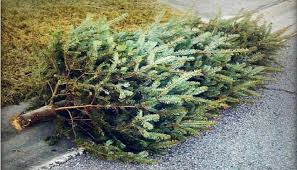
Christmas is a great time of the year. But when all is said and done, you’re often left with a full-sized tree in your living room. If you have a real tree, you can always put it out on the curb. Fortunately, many Rhode Island communities have programs designed to help you dispose of Christmas trees with a minimum of fuss.

But you also have several alternatives to putting your tree on the curb. Many of these are environmentally friendly and make great use of your tree. One little used way, for example, is to replant your tree in your backyard. Doing that is great way of retaining the fond memories of a holiday season.

Replanting Ball and Burlap Trees

You can replant balled and burlap Christmas trees. If this is your goal, consider buying a small live ball and burlap tree. Small live trees survive the transition from outdoors to indoors to outdoors better than large trees. Here are several tips on replanting a Christmas tree:

  • Dig a hole for the tree as soon as you can. That will help the tree’s chances of survival. If you wait until Christmas is over, the ground may be frozen.
  • Indoor conditions put trees at risk. So, keep the tree indoors for no longer than a week or a week and a half. Keeping it longer reduces its chances of surviving outdoors.
  • Keep the tree in a cold sheltered place. The tree has been harvested in the cold, so it’s already gone dormant. You want to keep it in this state before you replant it.
  • Place the tree in a draft-free location and away from heaters and vents. Wrap the root ball in plastic or wet sphagnum moss.
  • Keep the root ball damp in the house. It needs to stay damp as long as it’s in the house. You can use ice cubes or daily watering to keep the ball moist.
  • Take off the burlap bag and other coverings on the root ball first. Then place the Christmas tree in the hole and backfill the hole.

Now you’ve replanted your Christmas tree. It’s a great way of keeping the memories of the holiday season in your backyard if you have the space to do it.

Recycling Your Trunk-Cut Christmas Tree

You can’t replant a trunk-cut Christmas tree. Once the tree is separated from its roots, that’s it. You can replant it but you can do other things with it. Below we give you several alternatives to putting your tree out on the curb when it’s time to dispose of your tree. Make sure you remove all the lights, ornaments, and tinsel beforehand.

  1. Donate to habitat and restoration projects
  2. Create a backyard bird sanctuary
  3. Recycle the tree and for wood chips/mulch
  4. Use it locally for erosion control
  5. Remove branches and use them for pathway edging
  6. Remove plants and use them to protect delicate plants
  7. Take small branches and add to a mulch pile

You can also use the tree for a fish habitat. Small fish can lay eggs in them. Trees last about eight years in water. But get permission from your local authorities before dropping the tree in a lake or pond. Some municipalities create fish-friendly habitats with Christmas trees. Too many submerged trees, however, can cause problems.

Go to the Pick Your Own Christmas Tree website for more ways to recycle Christmas trees in Rhode Island. Or contact RI Tree at ritree@ritree.org. You can also call the office at 401-764-5885.

John Campanini is the technical director of the Rhode Island Tree Council (RI Tree). A graduate of the University of Rhode Island, he was city forester for Providence for more than twenty years before retiring.

Nine tips on keeping your Christmas Tree fresh

Buying the perfect Christmas tree is a challenge—no doubt about it. Keeping your tree fresh during Christmas is just as challenging, if not more so. But thanks to this summer’s increased dryness, keeping this year’s tree fresh will be more challenging. The dryness affected the quality and life span of this year’s Christmas trees. So, you’ll have to go to greater lengths this year to keep your tree fresh than you did last year:

Ideally, you’ll want to buy a suitable stand for the tree you buy. Look for a stand that holds at least a gallon of plain water. You’ll spend less time filling up the stand and more time enjoying your tree. If you have a tall, wide room, pick a stand that fits the tree’s size. If you’re putting your tree on a table, choose a small stand with a good-sized reservoir. Also, get an adjustable stand. It makes leveling the tree easier.

Tips on Keeping Your Tree Fresh

Here are nine tips on keeping your Christmas tree fresh:

  • Cut about half an inch more off the tree’s trunk. That exposes the tree’s vessel, enabling the tree to absorb water easier.
  • Avoid cutting the trunk at an angle or into a V-shape. That makes it harder to keep the tree in the stand and reduces the amount of water available to the tree. Also, avoid bruising the cut surface or getting it dirty.
  • Keep the outer layers of wood on the tree. That speeds up the intake of water after you cut the tree.
  • Put your tree in a stand with water immediately after cutting the tree. Keep the stand filled with water throughout the season. Check on water levels twice daily for the first week and then daily.
  • Use a stand with a traditional reservoir type. It’s among the most effective ways to maintain freshness and minimize needle loss problems.
  • Check out the devices available to help you maintain a constant water level in the stand. They work. Use them if you can.
  • Checking the temperature of the water isn’t necessary. The temperature doesn’t affect water uptake or the tree’s freshness. Use plain water.
  • Avoid putting the tree near heat sources like air vents, fireplaces, wood stoves, and sunny windows. That dries out the tree quickly.
  • Using lights that emit low heat, such as miniature lights, reduces drying and keeps the tree fresh.

Consider acclimating your tree before bringing it into your home. Going from a cold outdoor environment to a heated indoor can stress out a tree. So, you can store the tree in an unheated area, like your garage or basement, for a day or two before bringing it inside. Also, avoid using preservatives and other additives in the water. They won’t extend the life of your Christmas tree.

 
Photo credit: Andre Gorham via Unsplash

Fruit Trees Winter Preparation

Sometimes in winter……..

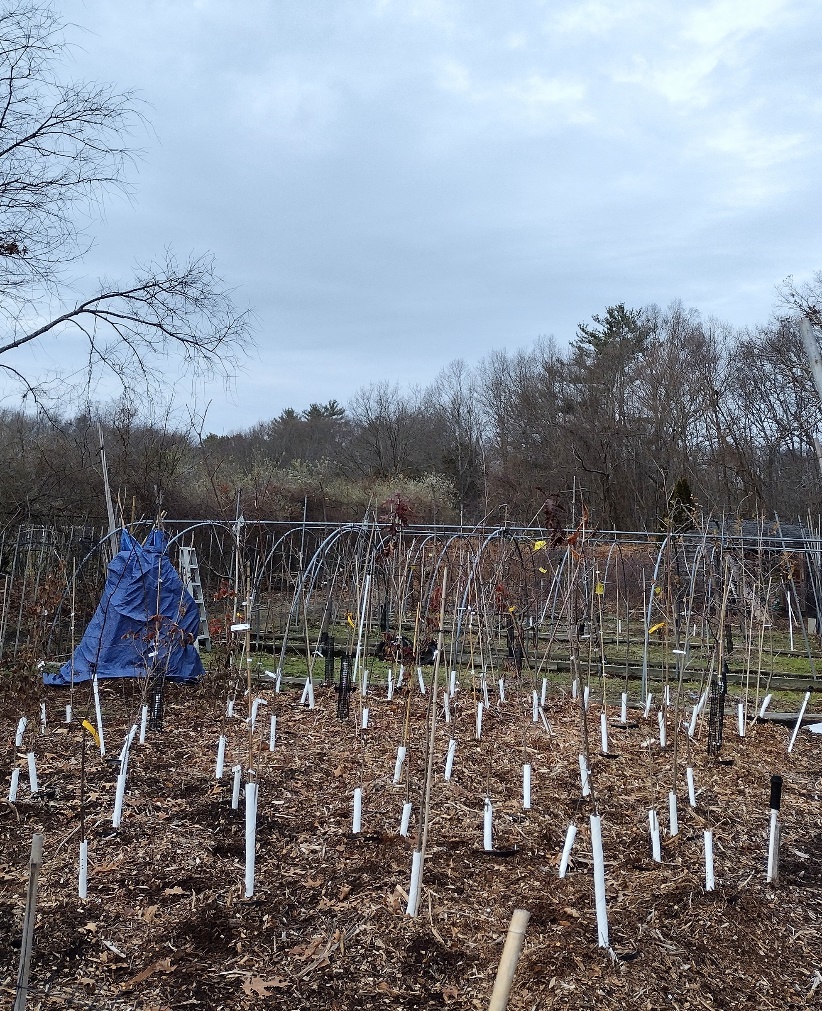
Busy year in the orchard and nursery. This class area held a handful of class sessions on fruit trees and pruning ornamentals. The trees displayed good growth and development.  While the vegetative growth and blooming were strong, fruit set and ripening faced severe challenges.  Crop production lacked swelling and ripening, many succumbing to varmint consumption.  For hygiene purposes, any debris on the ground was thoroughly removed.

Now with these activities complete, its time for winter preparation.  There has been installed a low deer barricade, to deter entrance to orchard and pruning area. To finish off the maintenance year is a liquid copper application for fungal reduction and prevention. This winter’s fig protection is cutting back branches, a healthy covering of mulch, and a tarpaulin tent. That is the blue item in the photo. There are a few types of trunk protection in use. There are sliced corrugated 8”tubes, pvc wraps and plastic mesh sleeves.  The primary goal is to protect the trunks from varmint damage. The pvc wraps are visible in the photo.

These measures of addressing evident and anticipated challenges are constant facet of landscape development. Observing the ongoing challenges and taking steps to reduce the negative consequences is the crux to maintaining a healthy beneficial landscape.  To see how this year’s efforts play out, please join us during the summer workshop series ( Growing Fruit Trees) with your questions.  Until then, enjoy the trees.

Author and Picture Credit Craig Hotchkiss, RITree Project Coordinator