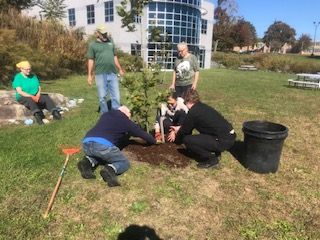
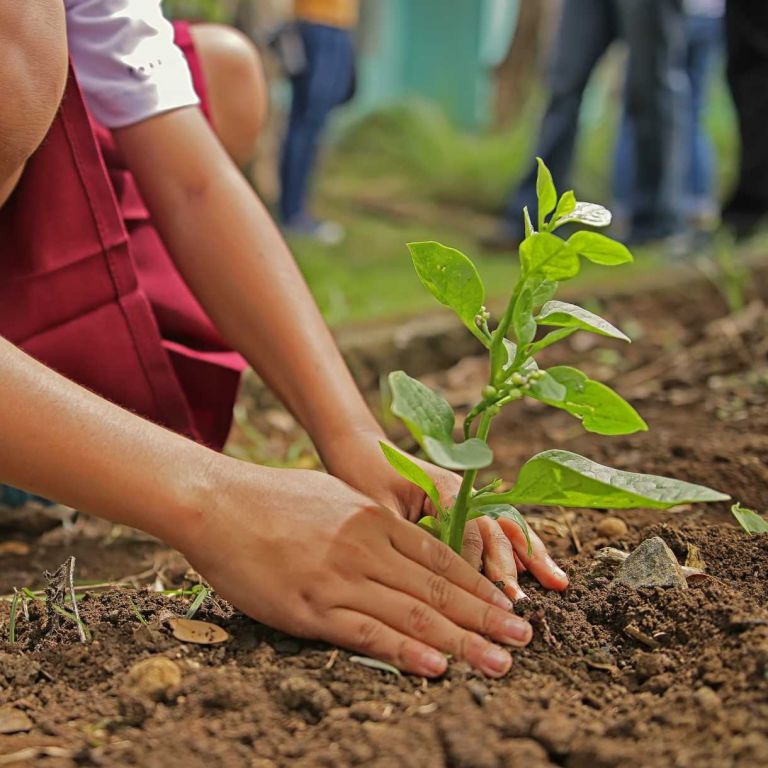
The 2022 Fall Tree Stewards Course held its Skills Workshop on the grounds of the Mohr Public Library, Johnston, RI on Saturday, October 22. At the workshop, the students planted trees and shrubs. They also performed routine and remedial pruning on small saplings and groupings of rhododendron and hydrangea growing at the library. The class ended with each student demonstrating the proper way to obtain a soil sample for soil testing.
Students finish planting a London planetree by adding a layer of mulch over the young tree’s root system.
The 2022 Fall Tree Steward’s Course Tree started on Tuesday, October 4 at the Mohr Public Library, Johnston, RI with a lecture on Tree Structure and Function. The course is composed of four weekly lectures and a Skills Workshop to be held on Saturday, October 25. The instructors are RITree’s Technical Director- John Campanini and Projects Coordinator- Craig Hotchkiss. Future lectures will discuss soils, tree planting and training and plant health care. To learn more about the Tree Stewards Course and how to register for future offerings, contact RITree at ritree@ritree.org.
Rhode Island Tree hosted Arbor Day 2022 at Wilson Park in North Kingston on April 29, 2022. It was the 135th Arbor Day Celebration for the state. Sponsors for the event included National Grid, RI DEM, and RI Tree.
Ralph Mollis, NK Town Manager, Greg Mancini, NK Town Council President, and Jack Read, United States Senate-RI all welcomed Arbor Day attendees. Dan McKee, Governor of Rhode Island, red the Arbor Day Proclamation. Rebecca P. Lamond, NK Town Planner, was the event’s host.
Arbor Day celebration included speeches by local and state officials and the Arbor Day Ceremonial Tree planting, an annual event recognizing the planting of an elm tree in honor of the first Arbor Day ceremony in 1886. This year’s ceremonial planting was a tulip tree.
The Arbor Day celebration also included presenting the 2021 Tree City and Tree Campus USA awards by Terry Gray, acting director, RI DEM, and Robert Allard, Urban & Community Forest Program coordinator.
The Tree City USA awards went to the following cities: Barrington, Bristol, Central Falls, East Providence, Jamestown, Middletown, Narraganset, Newport, Portsmouth, Providence, Warren, Warwick, and. West Warwick
The Tree Campus awards went to Bryant University, Johnson & Wales University, Providence Campus 3, and Salve Regina University (Providence Campus)
As part of the day’s celebration, RI Tree planted six London Planetrees, 2 Red Maple, 2 Sugar Maple, and 2 Cherry trees. North Kingstown is looking for volunteers to help them water these trees and establish them.
If you read Root Tips, RITree’s newsletter, you may be aware of our Growing Degrees Days (GDD) project. It monitors plant development and insect activity statewide from April through October with the help of volunteers. They collect daily weather data on air and soil temperature and precipitation and send RITree the results. RI Tree staff then uses the air temperature figures to calculate the daily, monthly, and yearly GDD count.
GDD is a hands-on tool for relating climate to plant and animal development. It tracks tree and shrub stages of growth and the presence of plant-attacking pests. Plus, it helps determine the best time for plant scouting and applying fertilizers and pesticides, the amount of heat stress on plants, and the proper time to harvest fruit and vegetables. These events impact the state’s landscape.
What Does GDD Measure?
GDD measures heat accumulation. Horticulturists, gardeners, and farmers use GDD to predict plant and insect development rates during a growing season. Different insect species require different amounts of heat or physiological time to go from one life stage to another. GDD tells us, for example, when an insect’s eggs are going to hatch and when vulnerable stages of certain insects will occur.
For example, the White pine weevil is a disfiguring insect pest of needled-leaf evergreens (Spruce, Fir and Pines), feeding on their terminal leaders, eventually killing them. Research indicates that this weevil is active in Rhode Island in April when the GDD count nears 55. Knowing this allows tree care providers to undertake plant protection measures with arrow-like precision, saving on labor and pesticides to boot.
Estimating the Base Threshold Temperature
A critical factor in determining GDD is an organism’s baseline temperature (or development threshold). Baseline temperature is the minimum temperature at which plants and insects grow. Different organisms have different baseline temperatures. That depends on a plant or insect’s physiology. Most temperate growing woody ornamentals, for example, (have a baseline temperature of 50°F
Plants and insects stop growing when the temperature drops below their baseline temperatures. Laboratory tests and field experiments have determined the threshold for many plants and insects. If a plant or insect lacks a baseline temperature, you can use 50°F—a number used for woody ornamental trees in the Northeast. Many plants and insects start growth at about 45-55 F.
Calculating Growing Degree Days
Calculating GDD is not that difficult. It only requires two steps. The first involves determining the average temperature by adding the daily low and high temperature and dividing this sum by 2. The next step calls for subtracting 50 (the baseline threshold) from the average temperature. Positive numbers are reported as the daily GDD count. Zero or negative numbers are recorded as 0.
For example, if a min/max thermometer indicates a low of 45°F and a high of 75°F, then the average temperature for the day was (48+76)/2 = 62°F. Next, subtract 50 from the average temperature. The result is 12 growing degree days or heating units.
Takeaway on Growing Degree Days
Many people use calendar days alone to determine plant and insect growth and development. This method works but can be misleading. Growing Degree Days is a better way to measure the growth and development of plants and insects.
When combined with the calendar method, it’s a far more accurate approach to tracking GDD than using calendars days by themselves. That’s especially true during the early stages of plant and insect growth.
GDD volunteers are a great help to us. As part of the project, we supply the measuring tools (rain gauge, thermometers, and so on) and training needed to implement the project.
If you’re interested in learning more about the GDD project or want to participate, contact RI Tree at (401) 764-5885 or Email us at ritree@ritree.org.
Watch for Home Invading Insects over the next 6 weeks. They include the Western Conifer Seed Bug, Brown Marmorated Stink Bug, Box-Elder Bug BEB, and the Asiatic Lady Bug. All are relatively harmless and feed on fruit and vegetable plants. They now are seeking warm shelters for winter protection. Check screens, doors, windows and weather-stripping for openings allowing these pest to enter the home. Check out the video for more details on Home Invaders.
RI Tree Council recently submitted verbal and written testimony in support of ‘The Forest Conservation Act’ before Senate and House Committees holding legislative hearings on the merits of this bill. The Act, if passed, will establish a Forest Conservation Commission charged with crafting measures to protect urban and rural tree resources from further decline.
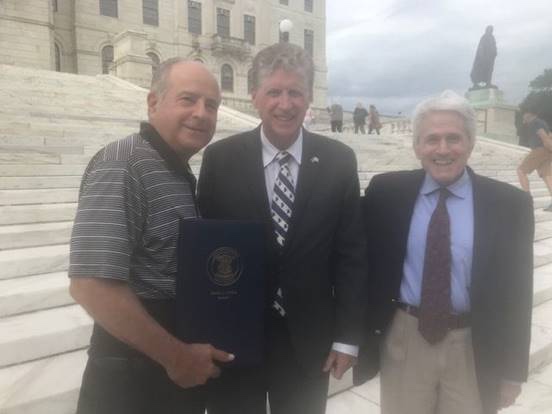
RITree’s John Campanini displays the signed copy of the Forest Conservation Act given to him by Governor Don McKee, center. Also pictured is Scott Wolf, Director Grow Smart RI, right.
On Tuesday, August 17, 2021, Governor Don McKee signed the Forestry Conservation Act into law. The Act creates a forest conservation commission to seek new funding and identify incentives for landowners to maintain their land as forest. The historic bill signing took place on the State House East Veranda overlooking Downtown Providence. RITree’s Technical Advisor John Campanini was on hand to witness the occasion.
RITree’s Annual Meeting was held on Saturday, September 11 at the Franciscan Missionaries of Mary, Fruit Hill Avenue, North Providence. The event featured awards, barbecue picnic, guided tree tour and tree planting. A total of 70 Tree Council members, volunteers and guests attended the afternoon affair. A total of 13 tree stewards were recognized with special community service pins and charms by Robin Enos- RITree’s Volunteer Coordinator. The event closed with the planting of two Bald Cypress saplings to honor the memory of the 3,361 Americans who lost their lives during the terrorist attacks that took place on September 11, 2001.
Awards were given to some of our outstanding Tree Stewards.
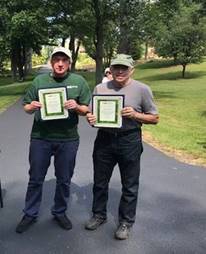
Michael Emma (L) and Andrew Sabo (R), were honored for participating in RI Tree’s Growing Degree Day Project at the Annual Meeting and Picnic, Saturday, September 11, 2021
Doris Alberg, Wendy Davis, Sister Anne Dundin, Lou DiToro, Michael Emma, David Flanders, Steve Higgins, Andy Sabo
RITree Growth Degree Team: David Brown, Tricia Cass, Bill DiMarco, Michael Emma, David Flanders, Melissa Hughes, Joe Jamroz, Roger Laberge, Hope Morrow, Joan Pelletier, Andy Sabo
City of Cranston Neighborhood Planting Program: Steven Stycos, Rick Degrandpre
Friends of Warwick Pond: Philip E’rcole and Committee
Warren Tree Commission: Charles Staton, E. Jenny Flanagan, Elizabeth Andreadis, Kathleen Pannoni, Marian L. Clark, Steve Patistea, Judy Fardig
West Bay Land Trust: Douglas Doe, Lisa Gibb, Angie Koziara, Heather Thibodeau
Thank you to all our Tree Stewards for sending us your volunteer hours, we couldn’t do it without you!
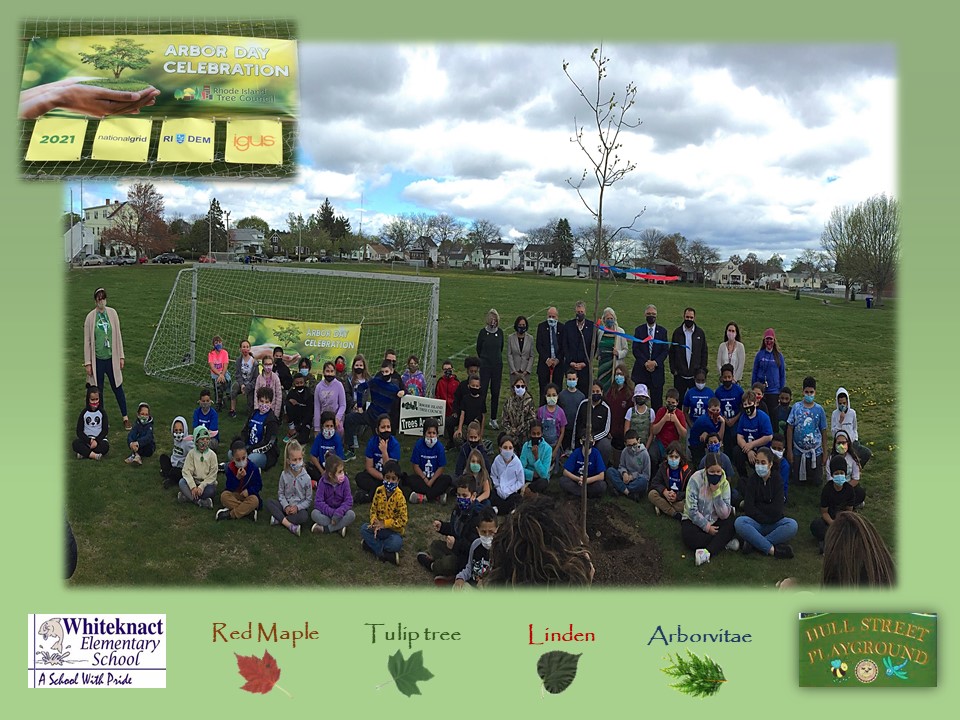
The 2021 Rhode Island Arbor Day was one of the best ever. Over 100 people attended the morning event held at Hull Street Park in East Providence on Friday April 29. Among the gathering was RI Governor Dan McKee, Lt. Governor Sabina Matos and East Providence Mayor Roberto DaSilva. But the day belonged to Whiteknact Elementary School students. They sang songs and helped to plant 15 saplings at the park. Later, they sat for a ‘team picture’ to mark the occasion of this very special tree holiday. The picture makes for a great keepsake and is available to download here.
One goal of RITree is to create links to, and boost communication with, community-based local, state, and Federal organizations. Community organizations we work with include:
Arbor Day 2019 was held at the Monsignor Gadoury School in Woonsocket. Matt and Dan Sweet of the Holy Trinity Parish hosted the event. RITC, National Grid, Rhode Island Department of Environmental Management all collaborated on the occasion.
Arbor Day 2019 included the planting of 22 trees. The trees planted included: European beech, Arborvitae, Lacebark Elm, Dogwood, Sugar maple, Red maple, Snowbell, and Tulip trees. The planting included established tree canopy on a significant portion of the area. With additional plantings on the property, the resultant canopy volume for the site may grow up to 15%, a more than healthy urban figure by any standard.
Arbor Day 2019 also included the announcement of an American Forests & Doris Duke Charitable Foundation grant for $_____________. This grant focuses on the relationships between trees and neighborhood health. Its goal is to _____________________. Activities involved include ___________________ . Representatives from the Doris Duke Foundation, RI Dept. of Health, American Forests, the Governor’s office and RIDEM were present for the announcement.