

Tree Care Tip
Seven Tips on Planting a Tree in the Fall
Fall is an excellent time to plant trees, especially after leaf drop (between September 15 and November 1). It offers significant advantages over spring planting, including good soil and weather conditions.
But first, you must select the right tree for the given area and then plant it properly. Below are the seven tips for doing that:
1. Examine the soil
Planting a tree in healthy soil is critical. You want soil that is rich in nutrients and that retains moisture. Make sure it has the right balance of nutrients, like nitrogen, phosphorus, and potassium.
You can send soil samples for testing to the Cooperative Extension, University of Rhode Island for a detailed analysis. Tel: 401-874-2900.
2. Analyze the existing conditions
The weather plays a key role in tree planting. Are there severe conditions that could hinder growth? Does the location receive full sun (6+ hours), partial sun (2-4 hours),
or shade? Also, think about the tree’s mature size and canopy spread. Avoid planting near buildings, sidewalks, or other structures.
3. Choose a suitable species
Research trees that grow well in your area. Check your USDA Plant Hardiness Zone and find species suited for your climate. Native trees are usually the best choice since they are already adapted to local weather and pests.
4. Purchase a healthy tree.
Scrutinize the tree. Check the root ball. Avoid balls with roots circling the container. Make sure the trunk is straight and free of wounds, cankers, or insect damage. The branches should be well-spaced with a strong, wide-angle of trunk attachment.
5. Dig the right-sized hole
Dig the hole no deeper than the tree’s root ball and 2-3 timesas wide. Digging a shallow, wide hole encourages the roots to grow into the soil. Plant a little high to allow for settling. Leave the bottom undisturbed.
6. Prepare the tree for planting
Remove the tree from its container or unwrap the burlap and wire cage if it’s a balled and burlapped tree. Locate the “root flare.” It should be at or slightly above the soil line when the tree is planted.
7. Plant and mulch the tree
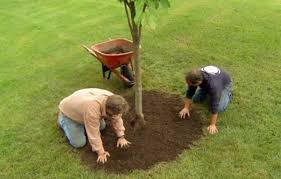
Place the tree in the center of the hole. Ensure it is straight from all angles. Backfill the hole with the soil you removed. Avoid using soil amendments, compost, or fertilizer; this helps the tree adapt to the native soil.
Finally, water the tree thoroughly. Then, apply a 2–4-inch layer of organic mulch in a “donut” shape around the tree. This helps the tree retain moisture, regulate soil temperature, and prevent weeds. Keep the mulch a few inches away from the trunk.