
7 Questions to Ask When Deciding to Remove a Tree

Deciding when to remove a tree is challenging for homeowners. Many factors, including the cost of tree work and any emotional ties to the tree, can impact the decision to remove a tree. A dying tree that doesn’t present hazards to people or property can be allowed to die in place without any human intervention.

But hazardous trees with structural weakness that endanger people and property need immediate attention.  Below are seven questions to help you decide if you need to remove a tree. Don Sepe, Sepe Tree Service, a licensed and certified tree removal company, answered the questions.

1.      Does the green stuff growing on my tree mean it’s dying?

No. That’s lichen. Lichen is a slow-growing plant that appears on walls, rocks, and trees. It’s not parasitic. It proliferates when exposed to full sunlight, which explains its profusion on dead trees. That often indicates that the air nearby is relatively pure. Most lichens won’t grow in a smoky or polluted atmosphere.

2.      Do large dead branches indicate that a tree is dying?

Not necessarily. Large dead branches endanger people and property. If less than 25% of the tree’s branches are damaged, the tree can survive. Remove any crossed or rubbing branches. Narrow branch angles—especially those on the main trunk—are prone to splitting. Remove these branches as well. These procedures are best done by an arborist.

3.      Is there trunk damage?

Internal decay in a tree often appears as vertical cracks, seams, dead branch stubs, and large, older wounds. If the tree has less than 25% damage to its trunk, the wounds can gradually heal without permanent injury. If the tree has more than 25% damage to its main trunk, you should remove it.

4.      Is the tree hollow?

Many trees can live for years with hollow trunks. That’s because the connective tissue of the tree—its xylem and phloem—are on the outer edges of the tree. The hollowness, however, compromises the trunk’s strength, making the tree a danger to people and property. So, remove the tree if one-third or more of the tree’s interior is hollow.

5.      Are there large dead branches?

Trees with large dead branches endanger people and property. So, do trees with broken tops. If less than 25% of the tree’s branches are dead, the tree can survive. Remove any crossed or rubbing branches. Narrow branch angles, especially of the main trunk, are also a concern. They’re prone to splitting. If a narrow crotch is too large to remove the two co-dominant leaders, cable them to relieve the strain and prevent them from breaking down. Contact an arborist to perform these procedures.

6.      Our tree is close to our house. Should we remove it?

Trees near a house can present a problem to homeowners, but you don’t always need to remove them. You can “crown raise” a tree to supply about 12-15 ft. of roof and house clearance. That keeps mold from growing on your house and prevents squirrels from jumping to your roof and nesting. You can also use tree growth regulators (TGR), which help control tree and shrub growth. TGRs keep the tree trimmer. Have an arborist come out and look at the tree and help you decide.

7.      Should I call an arborist to do my tree work?

Hiring an arborist to remove a tree is the safest and most cost-effective way to remove a tree. If you use your landscaper to remove the tree, however, make sure that he or she has the proper insurance to do the job. Landscape insurance doesn’t cover staff working at heights over 8 feet in the air. So, if an accident happens, you could be liable for any damage. No one wants that.

Answering these seven questions can help you decide whether to remove a tree. If you’re still not sure, talk with an arborist. He or she can help you make the right decision. If you need to remove a tree, use a professional tree removal service. It’s the best, most cost-effective approach to tree removal.

Sepe Tree Service is a full-service tree care company. Its owner, Don Sepe, Jr., has over 30 years of experience in tree removal and stump grinding. Sepe Tree is available 24 hours a day for emergency service. For more information, call 401-276-2828.
Nine tips on keeping your Christmas Tree fresh

Buying the perfect Christmas tree is a challenge—no doubt about it. Keeping your tree fresh during Christmas is just as challenging, if not more so. But thanks to this summer’s increased dryness, keeping this year’s tree fresh will be more challenging. The dryness affected the quality and life span of this year’s Christmas trees. So, you’ll have to go to greater lengths this year to keep your tree fresh than you did last year:

Ideally, you’ll want to buy a suitable stand for the tree you buy. Look for a stand that holds at least a gallon of plain water. You’ll spend less time filling up the stand and more time enjoying your tree. If you have a tall, wide room, pick a stand that fits the tree’s size. If you’re putting your tree on a table, choose a small stand with a good-sized reservoir. Also, get an adjustable stand. It makes leveling the tree easier.

Tips on Keeping Your Tree Fresh

Here are nine tips on keeping your Christmas tree fresh:

  • Cut about half an inch more off the tree’s trunk. That exposes the tree’s vessel, enabling the tree to absorb water easier.
  • Avoid cutting the trunk at an angle or into a V-shape. That makes it harder to keep the tree in the stand and reduces the amount of water available to the tree. Also, avoid bruising the cut surface or getting it dirty.
  • Keep the outer layers of wood on the tree. That speeds up the intake of water after you cut the tree.
  • Put your tree in a stand with water immediately after cutting the tree. Keep the stand filled with water throughout the season. Check on water levels twice daily for the first week and then daily.
  • Use a stand with a traditional reservoir type. It’s among the most effective ways to maintain freshness and minimize needle loss problems.
  • Check out the devices available to help you maintain a constant water level in the stand. They work. Use them if you can.
  • Checking the temperature of the water isn’t necessary. The temperature doesn’t affect water uptake or the tree’s freshness. Use plain water.
  • Avoid putting the tree near heat sources like air vents, fireplaces, wood stoves, and sunny windows. That dries out the tree quickly.
  • Using lights that emit low heat, such as miniature lights, reduces drying and keeps the tree fresh.

Consider acclimating your tree before bringing it into your home. Going from a cold outdoor environment to a heated indoor can stress out a tree. So, you can store the tree in an unheated area, like your garage or basement, for a day or two before bringing it inside. Also, avoid using preservatives and other additives in the water. They won’t extend the life of your Christmas tree.

 
Photo credit: Andre Gorham via Unsplash

Why Aerate your Soil? Some Easy Tips and Tricks for Healthier Trees

Take a second to picture a tree that you love – maybe it’s the big oak in your backyard, the street tree in front of your house, or the new ornamental tree that you just planted in your garden. You probably will do (a number of things²) several things to care for your tree – water it while it’s young or during a period of drought, mulch it in the springtime, or get it professionally pruned as it matures. 

You might also do some things to mitigate harm to the above-ground portions of the tree, like ask a builder not to hit the trunk or branches during a home renovation project. However, we generally don’t consider the potentially harmful effects of our every-day behavior on the health of our beloved trees, and consequently, fail to implement a few simple, but high-impact solutions.

Interacting with Our Trees

Let’s take those three hypothetical trees mentioned above. Maybe you picnic around that big oak in your backyard or dash underneath the canopy when it starts to rain. Maybe you walk across the sidewalk tree well in which your street tree is planted, while being careful not to hit the trunk as you open your car door. Maybe you water your ornamental tree, and then walk about the garden pulling weeds and tending to other plants.

These are all wonderful ways to interact with the trees at home or in our communities but walking repeatedly across the soil that’s covering tree roots (particularly when the soil is wet) is not one of them³.  This causes the soil to compact, squeezing out of it the water and oxygen  essential for healthy plant growth.

Water is an obvious plant requirement, but oxygen is just as necessary below ground as it is above. Without soil oxygen, the tree’s vascular systems cannot properly function and roots are unable to absorb water. There also are microbes and organisms underground that are beneficial to tree survival and need oxygen as well.


Spike Aeration Boosts Tree Health

Here at RI Tree Council, we (definitely) don’t want you to stop picnicking under your tree or wandering around your garden – and the good news is, you don’t have to! Here are some tips (and tricks) to perform soil aeration (the practice of loosening soil to create pathways between soil particles) so that you can keep your beloved trees healthy for years to come.

Spike aeration is the easiest way for home gardeners to aerate their soil on their own! Grab a spikey tool, like a hand cultivator, metal rake, or pitchfork and puncture the soil in a broad area all around your tree. This will allow it to become more porous so oxygen can access the roots and water can drain more readily through the soil. Be careful not to stab surface roots with your tool!

Aerate around your trees once or twice a year, in the spring and/or fall, and always follow-up with mulch (find a great video on how to properly mulch HERE). For mature trees that are starting to show their age, it might be best to aerate the soil, mulch a large area around the base, and then try your best to walk over the roots as little as possible. Mature trees tend to be even more vulnerable to soil compaction.


Lastly – be aware that a healthy-looking tree is not an indication that your soil is fine! The negative impacts of soil compaction might not become visible in the canopy for (a number of growing seasons) many years. Be proactive and build aeration into your annual tree care routine.

Want more tips about keeping your trees healthy, or planning for the installation of new woody plants? Check out RI Tree Council’s other articles on tree care HERE, or sign up for the next Tree Stewards course!

Soils Simplified

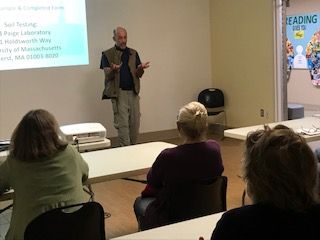
The second classroom lecture of the 2022 Tree Stewards Course took place on Tuesday evening, October 11 at the Mohr Library, Johnston, RI.  Soil Management was the topic.   Students learned about the important physical, chemical, and biological properties of soil.  They were also instructed on how to take a proper soil sample, interpret soil test results, and implement test recommendations.  Next week’s class will focus on tree and shrubbery pruning. 

RITree’s Instructor Craig Hotchkiss explains Soil pH and its importance in maintaining healthy soils.

Fall Foliage

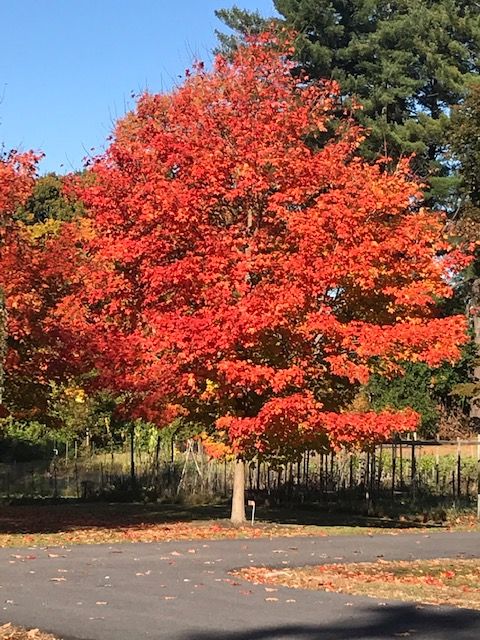
After a slow start, the fall foliage is finally turning colorful adding much splendor and beauty to the Rhode Island landscape. Trees leading the charge include the maples, birches, and dogwoods. Of this group, the Red maple is by far and away the star with its brilliant hues ranging from golden yellow to deep red-purple.  Many shrubs are also getting into the act. So far the Winged euonymus, viburnums and sumacs are the showiest.  Rainfall in late-September early-October helped to “activate” the pigments found in the leaves that are responsible for their recent color change.  But the leafy delight won’t last long as the leaves are already beginning to fall.  So enjoy nature’s wondrous beauty now before its too late.  Do you have a fall foliage favorite plant?  We’d like to see it.  Send us a photo at ritree@ritree.org.

Sugar maple clothed in red leaf finery is among the ‘best of breed’ plants for fall color. 

Spotted Lanternfly, an Invasive Pest Targeting Plants and Trees, Detected for the First Time this Year in Rhode Island

Published on Monday, August 22, 2022

PROVIDENCE, RI – The Department of Environmental Management (DEM) announces that the spotted lanternfly (SLF), an exotic pest that targets various plants and trees, has a detected population for the first time in Rhode Island. Native to Asia, SLF is most frequently associated with Tree of Heaven plants (Ailanthus altissima) and feeds on a wide range of agricultural crops such as grape, apple, and hops and several native species of plants and trees including maple, walnut, and willow.

Patches of SLF that were found along Route 7 in Smithfield indicate this is Rhode Island’s first find of a population of SLF. This was confirmed by US Department of Agriculture (USDA) last week. DEM is currently continuing to survey the area to get an idea of the extent of its spread. Additionally, DEM, USDA, and the University of Rhode Island (URI) are working on management options to minimize its spread. DEM’s Division of Agriculture and Forest Environment (DAFE) confirmed the sighting on Aug. 19 and is asking the public to report any suspected sightings at www.dem.ri.gov/reportspottedlanternfly. DEM will be conducting an extensive survey of the area based on USDA recommendations to determine if there is any further presence of the invasive insect and will be providing outreach materials to businesses in the area.

“In Rhode Island, we have about 69,000 acres of agricultural lands with many of those lands at risk of being infested with SLF including vineyards, orchards, berry crops, and nursery stock,” said Senior Environmental Planner Cynthia Kwolek . “It’s critical that we take the necessary steps to detect and stop the spread of this invasive pest, particularly since it has now been found in our state.”

DEM and URI conducted a statewide SLF survey in 2021 of local vineyards and areas with large populations of Tree of Heaven plants. Also in 2021, DEM and URI held a series of public workshops to help municipalities, the grower industry, and residents prepare for and respond to this pest, should it be detected in the state.

Along with spotted patterning, the adult SLF has scarlet underwings, yellow markings on the abdomen, and tan semi-transparent forewings. Adult lanternflies are about an inch long and are active from August until the first hard freeze, which typically occurs around late October into November.

Although SLF can fly distances on its own, it is an excellent hitchhiker and mainly spreads through human movement. Its inconspicuous egg masses can be laid on pallets, vehicles, and other goods, so it is important to inspect shipping materials and adhere to travel restrictions when moving through areas that are under quarantine for SLF. The following tips can help stop the spread of SLF:

o Inspect firewood, vehicles, outdoor furniture, and camping gear for egg masses, nymphs, and adults.

o If you visit states with SLF, check all your gear and equipment before leaving and scrape off any egg masses.

o Take a photo, squash the insect, and make a report to DEM’s agricultural pest alerts website.

SLF was first detected in Pennsylvania in 2014 and has quickly spread through surrounding states. An invasive plant-hopper that is currently infesting parts of the mid-Atlantic region of the United States, SLF has established populations in Pennsylvania, New Jersey, Maryland, Delaware, Virginia, Indiana, Ohio, and recently Michigan with finds of populations also in New York, Connecticut, and Massachusetts. In Pennsylvania, where the pest has been spreading for over six years, there has been significant yield loss in vineyards and the insect has become a public nuisance.

To learn more about SLF, visit DEM’s Agricultural Pest Alerts website or the URI website. To report a potential finding, please visit: www.dem.ri.gov/reportspottedlanternfly.

For more information on DEM programs and initiatives, visit www.dem.ri.gov. Follow DEM on Facebook, Twitter (@RhodeIslandDEM), or Instagram (@rhodeisland.dem) for timely updates.

https://ridem.wufoo.com/forms/spotted-lanternfly-sighting-report-form/

5 Little-Known Benefits of Urban Forests that Boost Quality of Life

By John Campanini

Urban forestry is vital to the health and well-being of today’s cities and towns. Technically, urban forestry includes planting, maintaining, caring for, and protecting trees in urban areas. It also includes the planned connections of the city’s green spaces, including landscaped boulevards, parks gardens, side tree boxes, and river and coastal walkways. Put simply, Urban forestry makes a difference in our lives often without us knowing it.

Urban forestry recognizes that trees are a critical part of a city’s urban infrastructure—from individual street trees and urban green spaces to shady school groves and suburban forests. Urban forests comprise much of America’s canopy. Altogether, over 140 million acres of America’s landscape are in the country’s cities and towns. Rhode Island is notable for its 286,000 acres of urban and community land with 52% overall tree cover.

Rhode Island also is among the top five of all US states for urban and community land as a percent of total state land area. Forests in Rhode Island cover 56% or 368,373 acres of state land. An estimated 213 acres or 58% of the state’s forested land is considered core forest, defined as blocks of forested land greater than 250 acres in size. The state’s 38,000 private landowners collectively control about 68% of the state’s forestland.

Benefits of Urban Forests

The Value of Rhode Island’s Forests, a joint project of the Rhode Island Advisory Committee and the Rhode Island Tree Council, provides a more in-depth look at what the state’s forests contribute to the community. The project was developed for the RI DEM Division of Forest Environment and made possible with funding from the USDA Forest Service. Below are some little-known benefits that Urban forestry in the state provide:

·         Trees cut air pollution.

Trees generate their food by combing carbon dioxide (CO2), water, sunlight, and soil elements. The process cleanses our atmosphere and releases oxygen for us to breathe. Trees also trap particular pollutants, like ash, pollen, smoke, and dust, and absorb CO2 and other dangerous gases harmful to living beings. Plus, trees produce enough oxygen on each acre for 18 people daily.

·         Trees fight the greenhouse effect

The greenhouse effect occurs when our atmosphere prevents heat from the sun from radiating back into space by air-polluting gases. That boosts temperatures globally and threatens everyone on the planet. Trees reduce the greenhouse effect. They shade homes and office buildings, cut air conditioning needs by about 30%, and reduce the impact the burning of fossil fuels for electricity has on our atmosphere.

·         Trees conserve water, cut soil erosion

If cities lacked trees, they’d have to increase sewerage and storm water drainage channels and add waste treatment capacities to deal with more water runoff. That can boost a city’s infrastructure costs dramatically. Trees help cut those costs. Tree roots, for example, increase soil permeability. That, in turn, reduces surface runoff of water from storms, cuts soil erosion and sedimentation, increases groundwater recharge, and reduces wind erosion of soil.

·         Trees reduce heat-related health problems

Excessive heat and airborne pollutants can dramatically increase health-related problems within an urban community. Trees reduce these problems. The moderate city temperatures decrease respiratory ailments caused by lowering airborne pollutants and supply relief in an often-stressful city life. Residents are also encouraged to walk in their neighborhoods daily when a beautiful tree landscape exists. This activity keeps people fit and encourages social interactions.

·         Trees boost economic stability

Cities that feature significant urban forestry thrive compared to those that don’t. Studies show that have an expanded urban forest:

  • Attractive more businesses and tourists
  • Help landlords rent apartments and offices faster
  • Boost employee productivity while cutting absenteeism
  • Encourage shoppers to shop longer along tree-lined streets
  • Boost a city’s pride and community spirit

Trees also help block or absorb city noise in an urban environment and help create a positive first impression among visitors.

Practical, Productive, and Practicable

The five items mentioned above are just some of the benefits urban forests provide. They also decrease crime, lower levels of social disorder, boost commercial property values, increase perceptions of safety, moderate local climate, and provide forage for humans and animals. These benefits grow over time. Trees strategically planted and maintained over time can generate returns up to three times the costs of planting and maintaining them.

Put simply, urban forests are not only productive and cost-effective but also practical and healthy. They provide economic, physical, social, emotional, and psychological benefits to a city’s residents. They also provide benefits for children. A recent study indicates the more interaction children with ADD have with nature, the more manageable their symptoms. With all these things going for urban forests, creating more of them makes sense.

 John Campanini is technical director of the Rhode Island Tree Council (RITree). A graduate of the University of Rhode Island, he was city forester for Providence for more than twenty years before retiring.

Now is a Great Time to Plant Spring Flowering Trees

Spring comes but once a year. For many, it’s the best time of the seasons. These people like it because the long wait through the snow and bad weather of the winter, with bare trees sleeping through the season, is over. Plus, there’s the promise of a new beginning and the start of great weather. Doing something outside in your yard or garden is a great way to get over your COVID-19 blues.

Planting a spring-flowering tree is a great outside project. What better way to introduce the new season than with a magnificent display of spring-flowering trees. These trees offer numerous benefits.  They reduce carbon dioxide levels, lower energy cost, prevent storm runoff, hide unattractive views, and raise a home’s resale value. A description of spring flowering species and their cultivars suitable for planting in Rhode Island is presented below.

·         Flowering Cherry  

These trees come in a wide variety of shapes and sizes. Many varieties bloom in springtime and last for several weeks. Cherry trees work well in residential gardens because they require minimal care. All are beautiful. Distinguishing characteristics include the sheer number of petals and the color of the blossoms, as well as their fragrances, leaves, and blooming season. Flowering cherry trees perform best in full sun in moist, relatively well-drained soils.  RITree’s Best of Breed selections are:

‘Accolade’ Sargent Cherry (Prunus sargentii  ‘Accolade’)

‘Kwanzan’ Japanese Flowering Cherry (P. serrulata ‘Kwanzan’)

·         Magnolias  

The magnolia tree, like the cherry tree, is best known for its flowers. Among the first trees to bloom in the spring, magnolia trees have large flowers and a sweet, heady fragrance. Their tulip- or star-shaped flowers are often as large as saucers when fully opened. The tree’s foliage and fruit are also attractive. Magnolia trees come in several varieties, are long-lived, and easy to plant. These hardy trees prefer full sun with soils that are well-drained and slightly acidic. Best of Breed selections are:

Saucer Magnolia (Magnolia x soulangeana)

Star Magnolia (M. stellata)

·         Dogwood  

These woodland trees appear in various forms around the U.S., giving us a beautiful and elegant spring spectacle. Dogwoods have wide graceful branches growing horizontally into layers, with each branch featuring colorful flowers from April to June.  Dogwoods are shallow-rooted and may require supplemental irrigation during summer to meet their water needs.  Dogwoods prefer partial shade to full sun and moist, acidic soils.  Best of Breed selections are:

Corneliancherry Dogwood (Cornus mas)- Yellow flowers

White Flowering Dogwood (C. florida ‘Cherokee Maiden’)

Pink Flowering Dogwood (C. florida var. rubra ‘Cherokee Chief’)

Milky Way Chinese Dogwood (C. kousa var. chinensis ‘Milky Way’)

·         Crabapple

The flowering crabapple tree is among the most prized of all spring-flowering trees. They’re a staple of landscape gardening.  Known for their spectacular display of magnificent blossoms in the spring and colorful fruit in the fall, these trees bloom for a four-to five-week period in mid-spring. Crabapples are extremely cold-hardy, air pollution tolerant and adaptable to a wide range of soils.  Best of Breed selections include:

‘Donald Wyman’ Crabapple (Malus x ‘Donald Wyman’) –White flower, Bright red fruit

‘Prairifire’ Crabapple (M. x ‘Prairiefire’) – Red flower, Red-purple fruit

Japanese Crabapple (M. floribunda) – Red fading to white flowers, yellow and red fruit

Choosing among these trees for your outside project may be challenging. Contact RITree for help in selecting the right spring flowering tree for your project or for more advice on how to plant them.

Tips on Caring for Big Trees

Big trees are under siege from a variety of threats. They need attention and care. Here are some tips on how to care for big, old trees:

  • Protect the bark from damage from yard equipment
  • Spread mulch around the base to insulate the soil
  • Avoid compacting the ground around a big tree
  • Keep branches free from hanging things
  • Water when dry to avoid stress when it’s hot

Also, big trees should be inspected by a certified arborist periodically. The arborist can spot trouble early, like diseases, rot, and heavy dead branches. He or she can also spot problems early and recommend pruning or other measures that can preserve the tree’s life.

Caterpillar Damage

While most spring defoliators (Winter moth, Cankerworms, Gypsy moth and Eastern Tent Caterpillar are mostly done for the season, the larvae of the Forest Tent Caterpillar (FTC) are still feeding on foliage. The larvae are black with hour-glass-like spots running down the middle of their abdomen. Treat with registered pesticide, if the infestation is heavy.

Caterpillar damage is pretty bad this year. For some plants, this was the second year in a row that they defoliated.

What’s next for the affected trees and shrubs?
Will they re-foliate?
What’s the prognosis for their long-term health?
Is there anything their owners can do to help?

READ Defoliation of Deciduous Trees written by RITree’s Technical Advisor to learn the answers to these and other questions.