

How to Transform Barren Land into Self-sustaining Forests10 Times Faster than Traditional Methods
by John Campanini, Technical Director, RI Tree
This article is the first in a series about the Miyawaki Method of reforestation—a revolutionary tool for combating climate change and restoring degraded landscapes.
The urgent need to restore forests has never been greater, largely due to climate change and biodiversity loss. Traditional tree-planting efforts, however, can seem like a losing battle. These plantations typically grow slowly and require extensive, long-term maintenance, such as watering and weeding, making them costly and resource-intensive.
These plantations often focus on timber production rather than ecological restoration and may experience low sapling survival rates due to poor soil conditions or inadequate adaptation to the local environment. Enter the Miyawaki Method of reforestation.
This method is an innovative approach to reforestation that’s quickly gaining popularity worldwide. Named after its creator, Japanese botanist Dr. Akira Miyawaki, this method emphasizes planting trees and creating entire ecosystems that mimic the complex processes of a natural forest.
Dr. Miyawaki’s technique speeds up this natural development, turning barren land into lush, self-sustaining forests up to 10 times faster than traditional reforestation methods. In short, it’s a way to grow a thriving, diverse forest in just a few years—a forest that actively fights climate change and restores wildlife.
How Does the Miyawaki Method Work?
How does the Miyawaki Method work? Start by examining the land and gaining a comprehensive understanding of it. Your goal is to analyze the soil to identify the native tree species that will thrive there. We’re not talking about importing exotic trees; instead, we’re focused on restoring the local ecosystem’s unique botanical heritage. A wide variety of species—often 30 to 50 different types—are selected, ensuring a diverse and vibrant ecosystem from the beginning.
Next, you need to prepare the soil for this innovative reforestation effort—a vital step to succeed with the Miyawaki Method and often overlooked. Just as a strong foundation is essential for a sturdy building, healthy soil is crucial for a thriving forest. Organic matter, such as compost and natural mulches, can be added to improve soil structure, water retention, and nutrient availability. The aim is to create the ideal environment for young trees to establish themselves quickly.
Next comes dense planting. Trees are planted close together, often with three to five saplings per square meter. This process stiumlates intense competition for sunlight, forcing young trees to grow upwards rapidly. That accelerates their development. Their intertwining root systems also establish a strong, stable network that shares nutrients and water underground. Above ground, the dense canopy quickly forms, creating a unique microclimate that reduces water evaporation and encourages the growth of other forest floor vegetation.
The initial years often require some dedicated care, primarily ensuring the saplings receive enough water and are protected from weeds. After just two to three years, however, the forest becomes highly self-sufficient, needing minimal human intervention. The results are nothing short of astounding. Miyawaki forests grow approximately ten times faster than conventional plantations. What might take a traditional forest 100 years to achieve in terms of density and biodiversity, a Miyawaki forest can accomplish in just a decade.
Principles Behind the Miyawaki Method
Unlike large-scale reforestation projects that require vast tracts of land, Miyawaki forests can be planted on surprisingly small plots – from neglected urban corners and industrial sites to schoolyards and community gardens. That makes the method a perfect solution for localized, community-driven environmental initiatives.
The science behind the Miyawaki Method includes:
• Competition for light drives vertical growth.
• Root systems intertwine, sharing nutrients and water.
• Microclimates created by dense canopies reduce evaporation.
• Creating a rich ecosystem from the outset.
• Attracting diverse flora and fauna quickly.
• Enhancing soil health and microbial activity.
• Increasing resistance to pests, diseases, and climate extremes.
Miyawaki Projects in Rhode Island
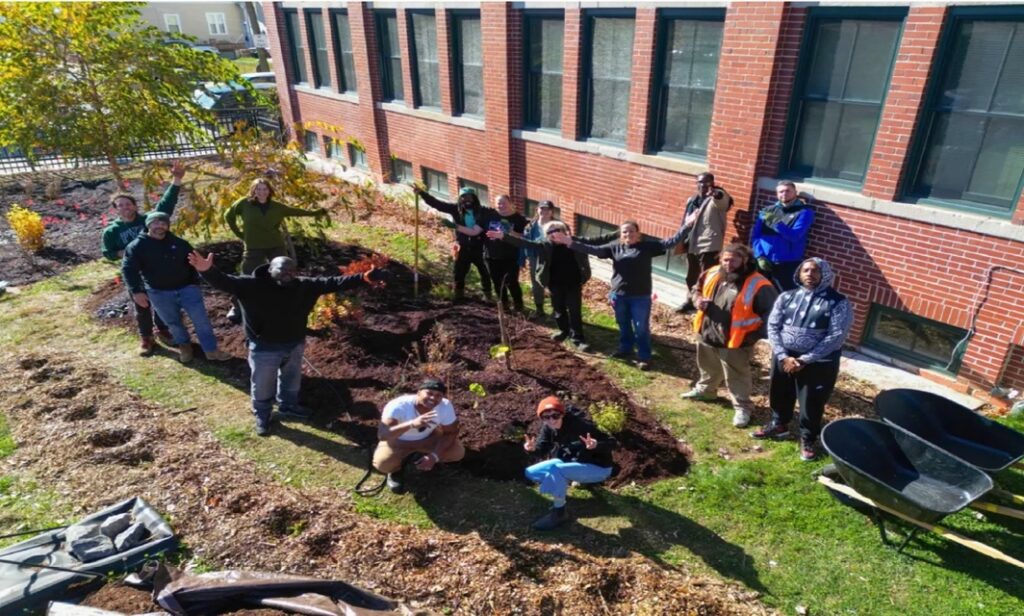
The examples below demonstrate a growing interest and implementation of the Miyawaki Method throughout New England, particularly in urban areas, to address climate change, enhance biodiversity, and create green spaces.
- Providence, RI (Pearl Street Garden): As of May 2025, a Miyawaki micro forest has been planted in the Pearl Street Garden in Providence’s South Side. This 1,000-square-foot area saw the planting of 260 native trees and shrubs.
- Providence, RI (Prairie Avenue): Groundwork Rhode Island also recently planted the city’s first micro forest on Prairie Avenue in South Providence, utilizing the Miyawaki Method.
These examples show the growing interest and implementation of the Miyawaki Method throughout New England, particularly in urban areas, to address climate change, enhance biodiversity, and create green spaces. Organizations like Biodiversity for a Livable Climate actively promote and facilitate these projects across the region.
The Miyawaki Method isn’t just a new planting technique. It testifies to the power of understanding and imitating nature. Creating dense, diverse, and rapidly growing native forests is a tangible and highly effective solution to some of our most pressing environmental challenges. Embracing and expanding the Miyawaki Method holds immense potential to reforest our planet, one vibrant, biodiverse mini-forest at a time.
In the next article, we’ll explore the benefits of the Miyawaki method more deeply and look at some of its pros and cons. For more information on this reforestation method and tips on how you can help implement it, contact RI Tree.