

Unleash Your Property’s Potential: Top 7 Secrets For Planting Saplings Successfully

Planting saplings can be challenging. One consideration is how they’re delivered. Planting balled and burlapped (B&B) saplings differs from planting bare-root saplings. B&B saplings are dug up with a soil ball around their roots, which is wrapped to maintain its shape. This state provides immediate soil contact and helps reduce transplant shock. Bare-root saplings have no soil around their roots, exposing them, but are lighter and usually less expensive, making it easier to inspect the root system.
These secrets on planting saplings can significantly improve their survival rate and long-term growth:
- Soak or dip bare roots: Avoid just briefly dunking bare roots. After soaking them for a few hours (no more than 24), dip them in a “root dip” product or a slurry of native soil and water before planting. This process helps coat the fine root hairs, preventing drying out during planting and ensuring immediate contact with soil particles, essential for nutrient and water uptake.
- Create a “watering donut” or berm: Instead of just leveling the soil around the sapling, build a small circular berm (like a donut) of soil about 1-2 feet in diameter around the tree. This technique funnels water straight to the root zone and prevents runoff, ensuring the sapling gets adequate hydration, especially in the first few critical years.
- Execute a “scratch test” for root ball girdling: Before planting, especially with containerized saplings, gently scratch the outer edge of the root ball. If you see roots circling aggressively around the perimeter, they are “girdling” and will eventually choke the tree. Untangling or pruning these roots encourages outward growth.
- Consider mycorrhizal fungi inoculation: While often overlooked, inoculating the planting hole with mycorrhizal fungi can dramatically benefit saplings. These fungi form a symbiotic relationship with tree roots, significantly improving the tree’s ability to absorb water and nutrients from the soil, especially phosphorus.
- “Air pruning” for pot-bound roots (if applicable): If your sapling is in a grow bag or fabric pot, these containers naturally “air prune” roots, preventing circling. If transplanting from a traditional plastic pot, gently rough up the outer roots or make a few vertical cuts with a clean blade to encourage outward growth and prevent the roots from continuing their circling pattern in the ground.
- Implement the “tilt test” for proper planting depth: When placing the sapling in the hole, hold it upright and then gently try to tilt it. If it feels stable and doesn’t easily flop over, the planting depth is likely correct. Ensure the root collar (where the roots meet the trunk) is at or slightly above ground level. Planting too deep is a common mistake that can suffocate the roots.
- Prioritize “structural pruning” early on (if needed): While often associated with mature trees, a little strategic structural pruning in the first year or two can guide the sapling’s growth into a strong, well-formed tree. Focus on removing competing leaders, crossing branches, or weak angles to encourage a dominant central leader and sturdy scaffold branches. This effort isn’t about heavy pruning, but thoughtful shaping.
RI Tree To Give Planting Workshops
RI Tree recently signed a three-year contract with the Green Infrastructure Center and the RI DEM to provide arboriculture workshops in the municipalities of Central Falls, Newport, Pawtucket, Warren, and Westerly. The workshops, tentatively scheduled for August, will train volunteers to plant saplings and prune trees.
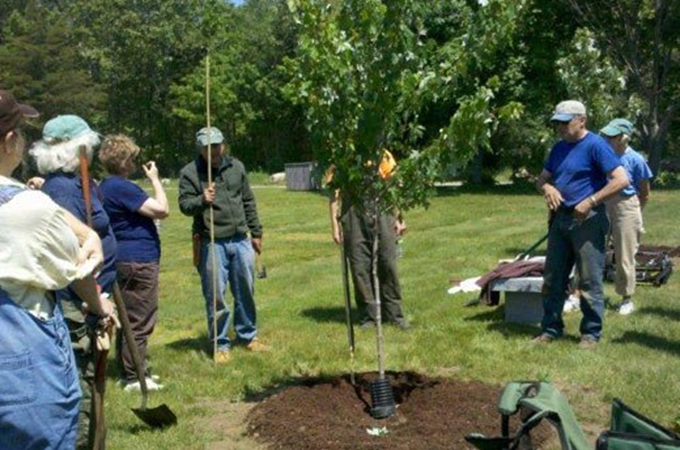
The workshops will cover the tree care principles published by the standards of the American National Standards Institute ANSI A300 Part 6—Tree, Shrub, and Other Woody Plant Maintenance-Standard Practices and Tree Planting Best Management Practices, a companion publication to ANSI A300.
Workshop Topics
The two-hour workshops will include planting two saplings—one container-grown (10 gallon) and one field-grown 1-1 ½ inch caliper, balled and burlapped. Topics covered in the workshops include:
- Urban soil advantages/disadvantages
- Nursery stock—types selection, handling
- Common sapling structure defects
- Proper use of training tools
- Proper execution of pruning cuts
- Root system evaluation
- Planting hole preparation
- Planting, mulching, and watering
- Staking
RI Tree staff and consultants will conduct the workshops. For more information, contact RI Tree. Workshop dates are to be determined.